
The short version
- Atomic swaps are real and they work. BTC ↔ XMR atomic swaps have been usable since 2020 and are now mature.
- The trust assumption is cryptographic, not human. The protocol guarantees that either both legs settle or both legs refund — no third party can steal mid-swap.
- The UX is improving but not yet competitive on small orders. A 30-minute handshake is fine for $50,000; less fine for $200.
- Aggregators trade some custody risk for much better UX. The aggregator briefly holds your deposit; the atomic swap never does. For typical amounts, the trade is worth it.
What an atomic swap actually is
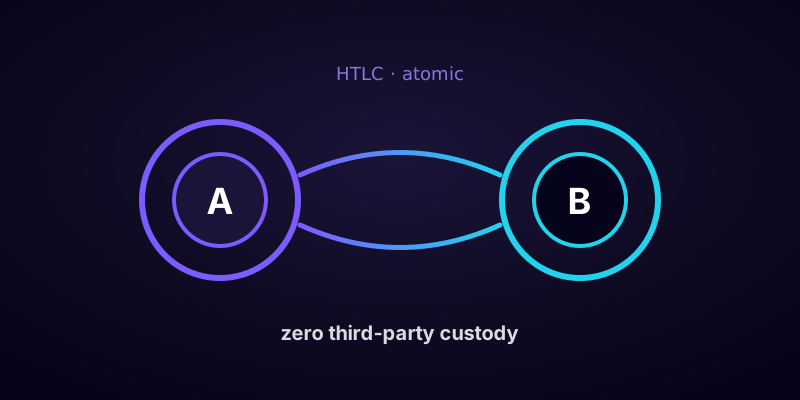
An atomic swap is a cross-chain trade between two parties who hold different assets and want to exchange them, enforced by cryptography on both chains so that one of two outcomes is mathematically guaranteed: both parties end up with the asset they wanted, or both parties end up with the asset they started with (after a time-lock expires). There is no outcome where one party gets the funds and the other is left holding nothing.
The mechanism is a hash time-locked contract (HTLC). At a high level: Alice locks her BTC behind a hash; Bob locks his XMR behind the same hash; whoever reveals the preimage first claims their counterparty's funds, and the act of claiming reveals the preimage to the counterparty, who can then claim too. If neither reveals before the time-lock expires, both can recover their original funds.
For BTC ↔ XMR specifically, the implementation is more subtle because Bitcoin's scripting language supports HTLCs natively while Monero's does not. The actual protocol uses an adaptor signature scheme that achieves the same atomicity property without requiring Monero to support hash time-locks directly. The mathematics is sound; the implementations are battle-tested.
The implementations that exist today
COMIT
The canonical BTC ↔ XMR atomic swap implementation, from the COMIT network. CLI-driven, requires both parties to run a node, requires both parties to be online simultaneously for the handshake (~30+ minutes). The reference implementation is open-source and audited. Production-ready for users comfortable with a terminal.
Farcaster
A GUI front-end on top of the COMIT protocol. Easier to use than the raw CLI, still requires a local node, still requires synchronous coordination. The right starting point for an atomic-swap-curious user who does not want to write JSON-RPC by hand.
Haveno
A fork of Bisq specifically for Monero. Provides a non-custodial marketplace with fiat and crypto pairs. Not strictly a pure atomic swap (it uses a multisig escrow with arbitrators for fiat trades) but lives in the same philosophical space — no central custodian. Useful for off-ramp scenarios where you want to convert XMR to local fiat without KYC.
UnstoppableSwap, MMRouter, others
Smaller implementations exist, some peer-to-peer marketplaces with embedded atomic swap support. The space is improving rapidly; the names will change. The underlying protocol is the durable thing.
When to use an atomic swap vs an aggregator
Use an atomic swap when
- Amount is large. Above ~$10,000 the spread saved (atomic swaps quote tighter than aggregators on big orders) typically justifies the UX cost.
- Threat model requires zero third-party custody. Aggregators hold your deposit for the duration of the swap — typically minutes, but non-zero. Atomic swaps hold nothing for either party at any moment.
- Principled preference for trust-minimised protocols. If you value the property of "no central point of trust" intrinsically, atomic swaps deliver it. Aggregators do not.
- Operational comfort with a terminal. The UX is acceptable but not great; you should be comfortable copying JSON-RPC commands.
Use an aggregator (NoKYCSwap) when
- Amount is typical. Under $5,000 the aggregator is faster, cheaper, and easier.
- You need it now. 8 minutes vs 30+ minutes matters when you are mid-task.
- You want a one-page UX. Aggregators are a widget; atomic swaps are a protocol.
- You do not have a counterparty online. Aggregators always have liquidity; atomic swaps need a willing peer.
A typical atomic-swap walkthrough (high level)
You will not run an atomic swap from this page — that requires a dedicated client. The mental model:
- Set up a peer connection. Run the COMIT/Farcaster client; either discover peers via the public network or coordinate with a specific peer out of band.
- Agree on amounts and the rate. Both peers quote; one accepts. The rate is locked in cryptographically.
- Each side locks funds behind the shared hash. Alice locks BTC; Bob locks XMR. Each lock is independently visible on-chain.
- One side reveals the preimage to claim. This automatically allows the other side to claim too.
- Both sides have what they wanted. The cryptography enforced atomicity; no third party was involved.
The whole thing takes 30–60 minutes in practice, dominated by Bitcoin confirmation depth on the locked side.
The trade-offs, summarised honestly
Aggregators (this site) and atomic swaps solve overlapping problems. The summary table:
- Custody during swap: aggregator briefly holds; atomic swap never holds.
- Time to settle: aggregator ~8 min; atomic swap ~30–60 min.
- Spread on $200 swap: aggregator ~0.5–1%; atomic swap can be wider due to setup cost.
- Spread on $50,000 swap: aggregator ~0.3–0.5%; atomic swap often tighter.
- UX: aggregator is a widget; atomic swap is a protocol.
- Counterparty availability: aggregator always works; atomic swap needs an online peer.
- Trust assumption: aggregator (and its upstream liquidity router); atomic-swap mathematics.
Neither dominates the other. They are complementary tools.
Related reading
- Bitcoin to Monero swap guide — the aggregator path.
- How to buy Monero without KYC — broader Monero acquisition.
- Private crypto explained — the threat-model background.
- Monero — coin overview