
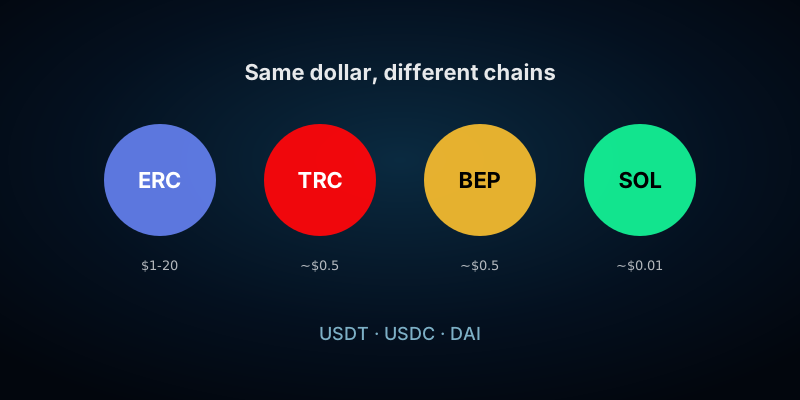
The short version
- Pick by use case, not by hype. Tron for cheap transfers; Solana for Solana DeFi; Ethereum for blue-chip DeFi; BSC for PancakeSwap-ecosystem; Polygon as the middle ground.
- The same dollar sits on multiple chains. USDT and USDC each exist on five+ networks. They are economically interchangeable but not on-chain.
- Cross-chain transfers cost fees. A USDT-ERC → USDT-TRC swap is a swap, not a free conversion.
- Issuer freeze is a real but rare risk. Tether and Circle both have the technical ability; both exercise it on a small number of addresses per year, almost always pursuant to legal process.
Why this matters
When you hold "USDT" or "USDC", you actually hold a specific on-chain token on a specific blockchain. The dollar value is the same; the operational properties (fees, finality, decentralisation, DeFi compatibility) differ enormously. Picking the wrong chain at deposit time means paying extra fees later to cross-chain into the right one, or — worse — finding that the application you wanted to use does not support your chain.
The networks, ranked
Ethereum (ERC-20)
- Fees: $1–20+ per transfer depending on gas.
- Finality: ~12 seconds per block; 12 confirmations (~2.5 min) for high confidence.
- Decentralisation: The most decentralised host chain.
- Liquidity: Deepest DeFi (Aave, Maker, Uniswap V3, Curve). Original USDT issuance.
- Right use case: Blue-chip DeFi, large holdings where fee is a small percentage of value.
Tron (TRC-20)
- Fees: Sub-dollar typically; free if you stake TRX for resource credits.
- Finality: ~3 seconds per block; ~20 confirmations recommended for exchange deposits.
- Decentralisation: Smallest validator set among major chains; high centralisation. Tether influence is significant.
- Liquidity: By volume, the most-used USDT chain in the world. Limited native DeFi.
- Right use case: Cheap cross-wallet transfers, the largest USDT chain by transaction volume.
Solana (SPL)
- Fees: Sub-cent per transfer.
- Finality: Sub-second under normal load.
- Decentralisation: ~3,000 validators, comparable to Ethereum in count but with lower-decentralisation patterns due to hardware requirements.
- Liquidity: Deep Solana DeFi (Jupiter, Drift, Kamino, MarginFi, Orca).
- Right use case: Solana DEX activity. The lowest-friction high-volume environment.
BNB Smart Chain (BEP-20)
- Fees: Sub-dollar typically.
- Finality: ~3 seconds per block; 15 confirmations standard.
- Decentralisation: 21 active validators. Binance influence is substantial.
- Liquidity: Deep PancakeSwap and BSC DeFi.
- Right use case: BSC ecosystem activity, BSC DEX trading.
Polygon (POL)
- Fees: Sub-cent typically.
- Finality: ~2 seconds per block; checkpoint to Ethereum every 30 minutes.
- Decentralisation: 100+ validators. Less decentralised than Ethereum but more so than BSC/Tron.
- Liquidity: Mid-tier for stables; large for gaming and NFT-adjacent activity.
- Right use case: The middle ground — cheaper than Ethereum, more decentralised than Tron/BSC.
Arbitrum (ARB)
- Fees: Cents typically; varies with Ethereum L1 calldata price.
- Finality: Fast on the rollup; 7-day finality to Ethereum mainnet (the optimistic challenge window).
- Decentralisation: Inherits Ethereum security via the rollup mechanism.
- Liquidity: Deep for GMX, Camelot, Pendle, Aave on Arbitrum.
- Right use case: Arbitrum-native DeFi.
USDT vs USDC, briefly
The two largest dollar stablecoins, with different issuer postures:
- USDT (Tether Limited): Quarterly attestation reports; reserve breakdown disclosed at the macro level. Larger total supply. Historically less regulator-friendly; more global retail use.
- USDC (Circle): Monthly attestation reports; reserve composition disclosed in detail. Smaller total supply. US-regulated; preferred by US institutions and risk-averse holders.
Both can be frozen at the contract level by their issuers. Both have done so on a small number of addresses, almost always pursuant to legal process.
DAI — the decentralised alternative
DAI is issued by MakerDAO/Sky via the Spark protocol. It is over-collateralised by a basket of assets (USDC, ETH, real-world assets including US Treasuries). There is no central issuer who can freeze DAI; the protocol governance can in extreme circumstances modify the system parameters but not unilaterally freeze user balances.
The trade-off: liquidity is shallower than USDT/USDC outside of Ethereum DeFi, and the spread on swap-aggregator routes is slightly wider. For users who value issuer-freeze resistance, DAI is the right choice; for most users USDT or USDC has better liquidity.
Cross-chain stablecoin operations
Moving stables across chains is a swap, not a free conversion. NoKYCSwap supports every major stable cross-chain pair:
- USDT-TRC → USDT-ERC
- USDT-ERC → USDT-TRC
- USDT-TRC → USDT-BSC
- USDT-TRC → USDT-Solana
- USDT-TRC → USDC
- USDC-ERC → USDC-TRC
- USDC → DAI
Typical spread on a stable-to-stable cross-chain swap: 0.2–0.5% inclusive of platform fee. Faster and cheaper than a bridge for most amounts; less so for very large amounts where a direct CCTP/bridge integration with Circle saves the spread.
Related reading
- USDT-TRC20 coin overview
- USDT-ERC20 coin overview
- USD Coin (ERC-20) coin overview
- DAI coin overview
- USDT to Monero guide
- Wallet hygiene for privacy swaps