
The short version
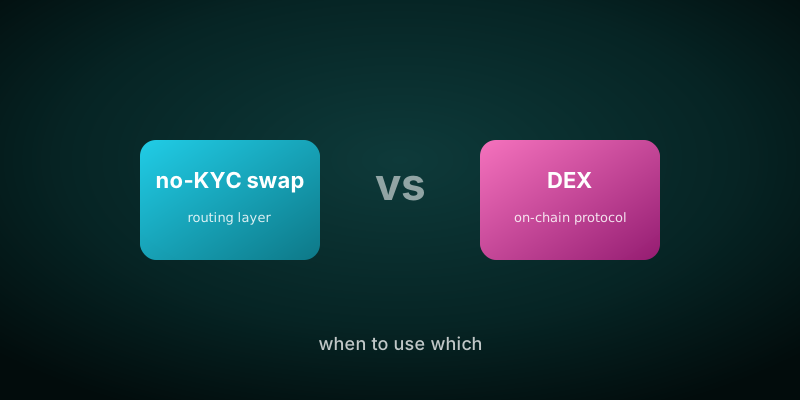
- Different architectures, overlapping use cases. A no-KYC swap is a routing layer; a DEX is an on-chain protocol.
- For cross-chain operations, a swap is simpler. One frontend, no bridges, no per-chain wallet setup.
- For same-chain operations on deep-liquidity pairs, a DEX is often cheaper. Especially for large amounts.
- Both are non-custodial in spirit. The trust model differs (aggregator briefly holds; DEX never holds), but neither is a custodial exchange.
- The right tool depends on the operation, not on ideology.
The two architectures
No-KYC swap (aggregator)
You paste a destination address for asset B. The aggregator gives you a deposit address for asset A. You send A; the aggregator routes through its liquidity venues and pays out B. The cryptography is straightforward: standard on-chain transactions on each leg. The trust model: the aggregator briefly holds (or routes through a partner who briefly holds) your deposit between confirmation and payout.
DEX (decentralised exchange)
You connect a wallet to a DEX frontend. The DEX is an on-chain smart contract that holds liquidity pools or matches orders. You sign a transaction that swaps your asset for the counterparty's asset through the pool, executing atomically on-chain. The trust model: no third party holds at any moment; the smart contract is open-source and audited.
When to use a no-KYC swap
Cross-chain operations
BTC → XMR. ETH → BTC. USDT-ERC → USDT-SOL. DOGE → USDT. Any pair where the source and destination live on different chains. Doing this through DEXs requires bridging, which has its own costs and risks (bridge hacks have been the largest loss category in DeFi). A no-KYC swap routes natively on each chain — no wrapped tokens, no bridge step.
You don't have a wallet on the destination chain
If you hold Bitcoin and want Monero, but you have not set up a Monero wallet yet, a no-KYC swap is the path of least resistance — you generate a Monero address (after installing a wallet) and paste it as the destination. The aggregator handles everything else. With a DEX, you would need a wallet, gas, and liquidity for each chain in the path.
You are not DeFi-native
DEXs require comfort with: connecting wallets, signing typed messages, approving token allowances, handling slippage settings, watching for sandwich attacks. None of this is hard, but the learning curve is real. A no-KYC swap is a widget: paste, send, receive.
One destination, many sources
If you want XMR and you have a basket of source assets (some BTC, some ETH, some USDT), executing six DEX swaps + bridges is slow and expensive. Six no-KYC swaps is fast.
When to use a DEX
Same-chain, deep-liquidity pair
ETH → USDC on Ethereum mainnet. SOL → USDC on Solana. WBTC → ETH on Arbitrum. Pairs that have hundreds of millions of dollars in DEX liquidity quote very tight spreads — often a few basis points on a normal-size swap. No-KYC swap aggregators cannot beat that because they charge a platform fee on top.
Long-tail tokens
If the token is not on the aggregator's supported list — newly-launched memecoins, ecosystem tokens, governance tokens of small protocols — the DEX is your only option. Most no-KYC swap aggregators list around 500–1,500 tokens; DEXs list thousands per chain.
Limit orders
You want to buy ETH if the price drops to $X. You want to sell XMR if the price rises to $Y. No-KYC swap aggregators are market-order only; DEXs (and DEX aggregators with limit-order modules like 1inch Fusion or Jupiter Limit) support this.
Threat model: zero third-party custody, ever
The aggregator holds your deposit between confirmation and payout — typically minutes, but non-zero. If your threat model is "no third party should ever hold my funds, even for a minute," DEXs (atomic on-chain settlement) fit better. So do atomic swaps (cross-chain, also zero third-party custody).
The cross-chain DEX middle ground
THORChain is a DEX that does native cross-chain liquidity. Real BTC on one side, real ETH on the other, no wrappers. The trust model is closer to a DEX than to an aggregator — the chain itself holds the liquidity and routes via cryptography rather than via a third-party custodian. The trade-off: the user interface is more complex (you interact with a Cosmos-SDK chain through a wallet that supports THORChain), liquidity is smaller than aggregator routes, and the spread is wider on small orders.
For users who want the maximally trust-minimised cross-chain swap experience, THORChain is the right pick. For users who want the simplest one-page UX with broadly-equivalent privacy properties, an aggregator (like NoKYCSwap) is.
Combining the two
A common pattern: use a no-KYC swap to bridge the chains, and a DEX for the final precise execution. Example:
- Hold BTC. Want a specific Solana memecoin that no aggregator lists.
- No-KYC swap BTC → SOL.
- DEX swap SOL → target memecoin on Jupiter.
Or the reverse for cash-out:
- Hold a long-tail ERC-20 token. Want stablecoin.
- DEX swap token → USDC on Uniswap.
- No-KYC swap USDC → USDT-TRC for cheap transfer.
Related reading
- Atomic swaps explained
- Bitcoin to Monero swap guide
- Wallet hygiene for privacy swaps
- Stablecoin chains compared
- Uniswap coin overview
- THORChain coin overview